
Key Takeaways
- AI adoption in email is concentrated in content production. Personalization, automation, and deliverability, where the bigger revenue gains sit, get far less attention.
- Personalization is moving from broad segments, like geography and demographics, to individual, predictive targeting.
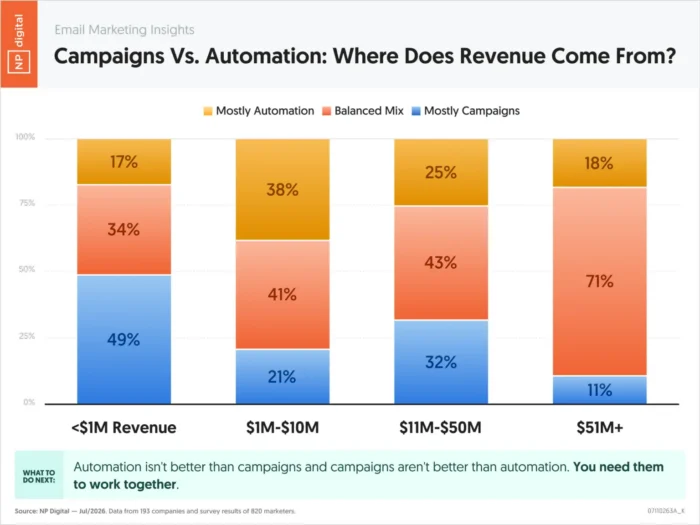
- Automation’s share of email revenue grows with company size. Businesses over $51 million in revenue get 71 percent of email revenue from automation versus 11 percent from campaigns.
- Nearly a fifth of sent emails never reach the inbox, and most of that loss happens before a subscriber has any chance to engage.
- The programs that win connect personalization, automation, and deliverability into a single system that reinforces itself.
Have you noticed your team is sending more emails than ever, but the results don’t feel any different?
Most marketers are pointing AI at email marketing’s wrong problem. The real opportunity is understanding customer intent, automating decisions, and personalizing experiences at scale. Most teams are using AI to write more emails without fixing the parts of the program that actually drive revenue.
Email personalization, automation, and deliverability are the three areas that actually move that revenue. Inboxes are getting louder as AI makes content creation easier, and louder rarely means more relevant. The rest of this post walks through what’s changing in each area, and how to build them into one connected system.
The AI Shift: What’s Changing in Email Marketing
Marketing teams are under real pressure right now: do more with fewer resources, scale personalization, improve retention and lifetime value, and increase marketing efficiency, all at once. AI looks like the obvious answer.
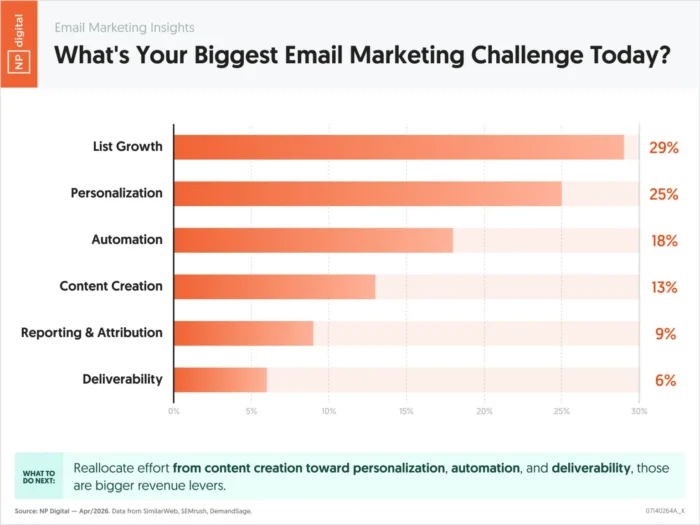
The problem is where that AI effort is actually going. Ask marketers what their biggest email challenge is today, and list growth tops the list at 29 percent, followed by personalization at 25 percent. Deliverability comes in last, at just 6 percent, even though it’s the foundation everything else depends on. An email that never reaches the inbox can’t be personalized or well-timed enough to matter.
Source
The New Email Marketing Framework
Here’s how the pieces break down:
- Personalization: delivering the right message.
- Automation: delivering it at the right moment.
- Deliverability: making sure it reaches the inbox at all.
You can’t improve these levers in isolation and expect the same lift each time. A gain in one gets erased by a gap in another. Perfect personalization that lands in spam accomplishes nothing, and flawless deliverability paired with generic, one-size-fits-all messaging just means more people ignoring an email they did receive.
Personalization in the AI Era
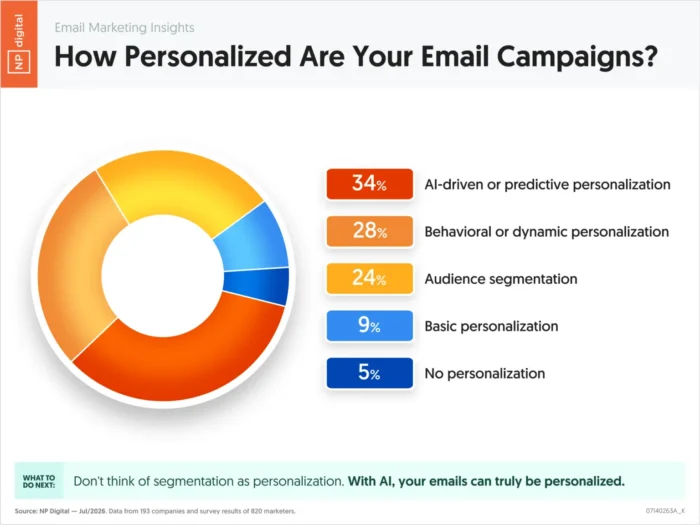
Most brands are stuck in what amounts to a segmentation trap. They personalize using broad buckets, new versus returning customers, geography, industry, demographics, and call it personalization. Only 34 percent of companies actually use AI-driven or predictive email marketing personalization. Another 24 percent are still at basic audience segmentation, and 5 percent use no personalization at all.
Most teams have the customer data needed for real personalization, they just aren’t using it to predict what happens next. Teams rate themselves strongest in measurement and attribution, with 55 percent calling that capability strong or very advanced. They rate themselves weakest in customer data and identity, at just 37 percent strong or advanced, along with AI skills and governance.
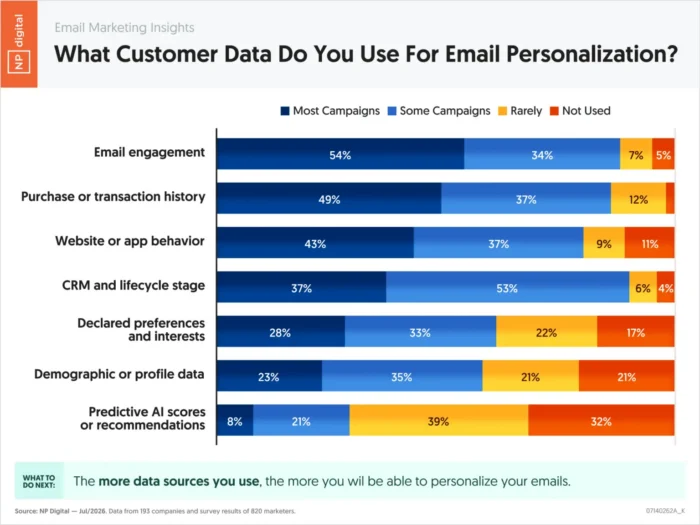
Personalization moves through three stages. Demographic personalization (location, age, gender) is the easiest to set up but produces broad assumptions and low relevance. Behavioral personalization (products viewed, purchases, engagement) produces higher engagement and better conversion. Predictive personalization goes a step further, using purchase likelihood, churn risk, and lifetime value to guide what happens next.
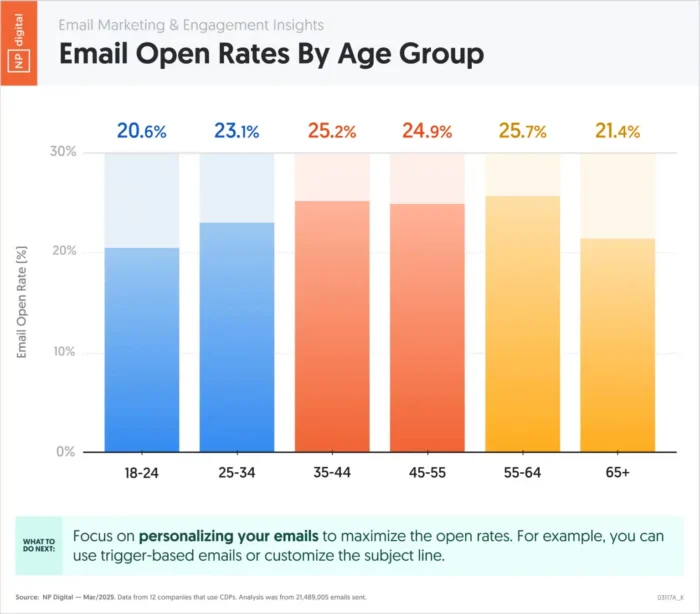
Open rates already vary by age group, from roughly 20.6 percent among 18-24-year-olds up to 25.7 percent among 55-64-year-olds, which makes a strong case for layering behavioral and predictive signals on top of basic demographic segmentation.
Source
Four tactics you can implement this week: dynamic product recommendations based on browsing and purchase history, dynamic content blocks that swap headlines and offers by segment, send-time optimization based on when a subscriber actually engages, and predictive offers built around what a subscriber is likely to buy next.
Source
Automation That Actually Drives Revenue
Campaign marketing runs on a simple loop: campaign, send, repeat. Lifecycle marketing works differently. A customer action triggers an automated response, no one has to remember to hit send.
That shift matters more as companies grow. Businesses earning less than $1 million get 49 percent of their email revenue from campaigns. That flips as revenue scales. Companies earning over $51 million get 71 percent of email revenue from automation and just 11 percent from campaigns. Manual scheduling shows up as inconsistent customer journeys, day-to-day operational inefficiency, and revenue a trigger would have caught but a person missed.
Source
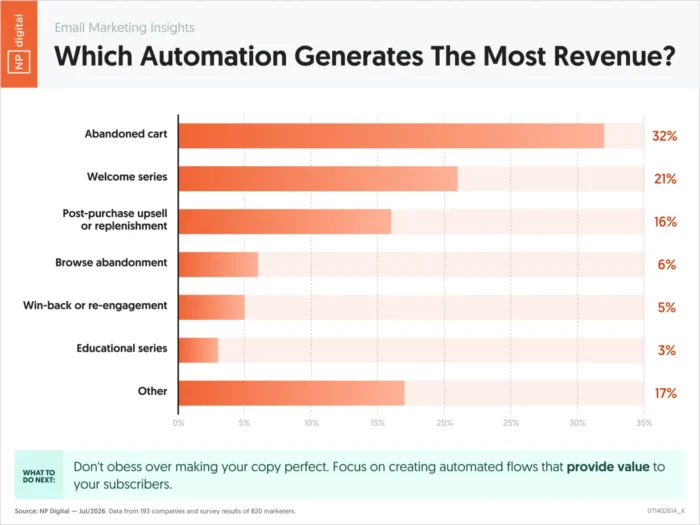
Some automations pull far more weight than others. Abandoned cart drives the largest share of automation revenue at 32 percent, followed by welcome series at 21 percent and post-purchase upsell or replenishment at 16 percent.
Post-purchase flows compound in a way that’s easy to underestimate. Email marketing lifts repurchase rate by 31 percent and shortens time to repurchase by roughly 8 days, and that gain repeats across your entire customer base.
Automation maturity builds in stages. Triggered campaigns just need a trigger to fire. Behavioral automation needs data on what people actually do. Predictive lifecycle marketing needs AI making the calls on timing and offers.
Source
Deliverability: Why Great Emails Still Land in Spam
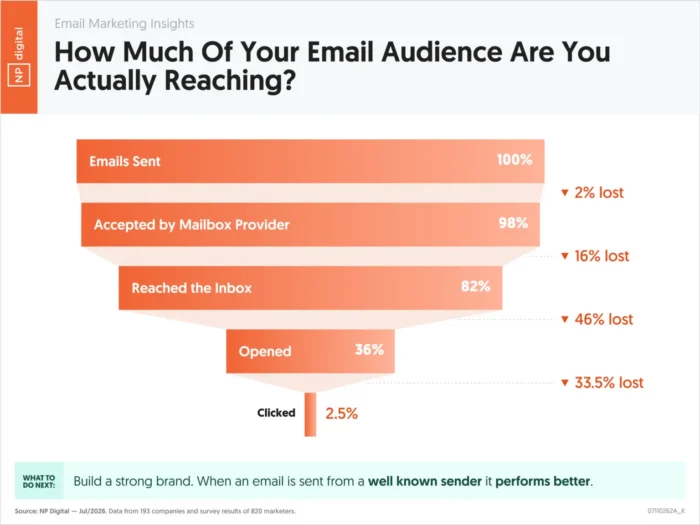
Here’s how much audience a typical send loses before anyone has a chance to engage. Of emails sent, 98 percent get accepted by the mailbox provider, but only 82 percent actually reach the inbox. Only 36 percent get opened, and only 2.5 percent get clicked. Every stage between send and click loses part of your audience, and most of that loss happens before a subscriber ever sees the email.
Inbox providers are changing the rules on this. They increasingly use AI to decide which emails reach the inbox, which get filtered, and which senders get trusted at all. Marketers tend to rank authentication and open rate as what matters most, but inbox providers weight sender and domain reputation and spam complaints far more heavily. Trust signals like replies and complaint rates are quietly deciding who gets filtered, whether marketers are watching them or not.
Email deliverability best practices rest on authentication (SPF, DKIM, DMARC), sender reputation built through engagement and damaged by complaints, and list quality, where a smaller engaged audience consistently outperforms a larger inactive one. Good list hygiene reinforces each of these: segment by engagement, purchase behavior, and activity recency, then back that up with re-engagement campaigns, sunset policies, and suppression strategies for contacts who’ve gone quiet.
Higher send frequency can shrink your effective audience instead of growing it. Open rates decline as cadence increases, from 33.8 percent at one send a week down to 26.2 percent at five or more, and volume without value trains subscribers to stop opening. Affiliate emails and cold emails carry the highest unsubscribe and spam complaint rates of any email type. The most common mistakes behind poor email deliverability are excessive frequency, poor segmentation, purchased lists, misleading subject lines, and ignoring inactive subscribers instead of suppressing them.
Source
Building the AI Email Marketing Operating System
Personalization, automation, and deliverability only work as one system. Personalization without deliverability never gets read. Automation without personalization feels robotic. Deliverability without automation can’t scale past what a person can manually manage.
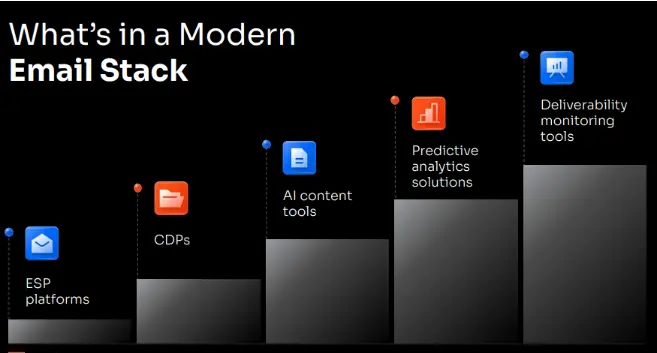
A modern email stack needs five pieces working together: an ESP platform, a customer data platform, AI content tools, predictive analytics, and deliverability monitoring. Most teams already have some of these, but few have them talking to each other.
That disconnect shows up in where AI investment is actually going. Teams are pouring the most effort into content creation and paid media optimization, the two areas with the highest percentage of teams applying AI. Personalization and marketing automation get far less investment, despite rating comparable or higher on effectiveness. Investment is going toward the easiest wins, even though personalization and automation are rated as more effective.
The future email team blends strategy, data, automation, and AI into a single connected workflow from the start.
The 90-Day Action Plan
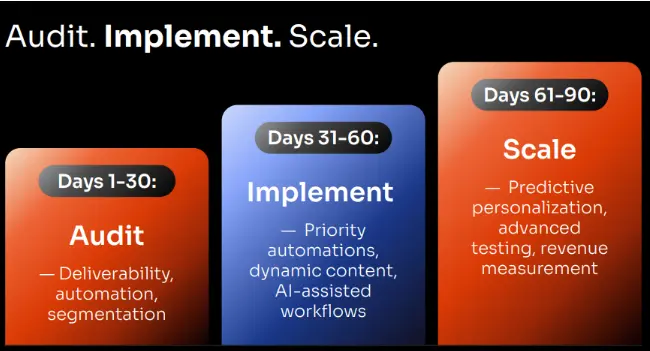
Trying to fix personalization, automation, and deliverability all at once is how most programs stall. Sequencing beats doing everything simultaneously.
- Days 1 to 30 (Audit): Review deliverability, automation, and segmentation to find the weakest link in your current program.
- Days 31 to 60 (Implement): Build the priority automations, dynamic content, and AI-assisted workflows the audit surfaced.
- Days 61 to 90 (Scale): Layer in predictive personalization, advanced testing, and revenue measurement once the foundation holds.
The sequencing matters more than the individual tactics. Predictive personalization and recommendations account for the largest single share of incremental business impact among AI email initiatives, at 31 percent, and impact compounds as each subsequent initiative builds on the last, reaching 100 percent cumulative impact across all five. Sequence each initiative starting with whichever is easiest to implement, and let each one build on the last.
FAQs
What is AI email personalization?
AI email personalization uses behavioral and predictive data, like purchase likelihood, churn risk, or browsing history, to tailor subject lines, content, and offers to each subscriber individually.
How do I improve email deliverability?
Focus on authentication (SPF, DKIM, DMARC), sender reputation built through consistent engagement, and list quality maintained through regular re-engagement campaigns and suppression of inactive contacts.
What email automations have the highest ROI?
Abandoned cart, welcome series, and post-purchase upsell or replenishment automations drive the largest share of automation revenue. Browse abandonment and re-engagement automations round out the five workflows worth building first.
How much should I automate vs. send as campaigns?
It depends on company size and program maturity, but the trend is clear: larger, more mature email programs shift the majority of their revenue toward automation. Businesses over $51 million in revenue get 71 percent of email revenue from automation, compared to 49 percent from campaigns at businesses under $1 million.
{
“@context”: ”
“@type”: “FAQPage”,
“mainEntity”: [
{
“@type”: “Question”,
“name”: “What is AI email personalization?”,
“acceptedAnswer”: {
“@type”: “Answer”,
“text”: “
AI email personalization uses behavioral and predictive data, like purchase likelihood, churn risk, or browsing history, to tailor subject lines, content, and offers to each subscriber individually.
”
}
}
, {
“@type”: “Question”,
“name”: “How do I improve email deliverability?”,
“acceptedAnswer”: {
“@type”: “Answer”,
“text”: “
Focus on authentication (SPF, DKIM, DMARC), sender reputation built through consistent engagement, and list quality maintained through regular re-engagement campaigns and suppression of inactive contacts.
”
}
}
, {
“@type”: “Question”,
“name”: “What email automations have the highest ROI?”,
“acceptedAnswer”: {
“@type”: “Answer”,
“text”: “
Abandoned cart, welcome series, and post-purchase upsell or replenishment automations drive the largest share of automation revenue. Browse abandonment and re-engagement automations round out the five workflows worth building first.
”
}
}
, {
“@type”: “Question”,
“name”: “How much should I automate vs. send as campaigns?”,
“acceptedAnswer”: {
“@type”: “Answer”,
“text”: “
It depends on company size and program maturity, but the trend is clear: larger, more mature email programs shift the majority of their revenue toward automation. Businesses over $51 million in revenue get 71 percent of email revenue from automation, compared to 49 percent from campaigns at businesses under $1 million.
”
}
}
]
}
Conclusion
AI raises the ceiling on an email program that already has strong fundamentals in place.
Personalization, automation, and deliverability function as one integrated system. A gap in any one of them limits what the other two can do. Brands that build these pillars in sequence see the gains compound faster than brands trying to fix everything simultaneously.
If you’re not sure where your program is weakest, NP Digital’s guide to email marketing is a good place to start auditing the fundamentals.








Leave a Reply