
More than 600,000 people die from malaria every year. Will climate change make this worse?
Climate change could make a number of infectious diseases worse. I expected malaria would be one of them.
That’s concerning, given the huge global burden that it already carries: it kills almost half a million children every year.
But a more complex story emerges from the scientific literature. One where rising temperatures could actually reduce the burden of malaria in some areas, while making it worse in others.
What impact has climate change already had on malaria? Will it make the global fight against it harder or easier in the future?
These are the questions that I want to answer here.
Before we look at how climate change could change the dynamics and distribution of malaria in the future, we need a quick primer on the global burden of the disease today.
This is important because climate change could cause a decline in malaria in some regions, while increasing the prevalence in others. The impact on the overall global burden of malaria will mostly depend on what happens in the worst-affected regions today.
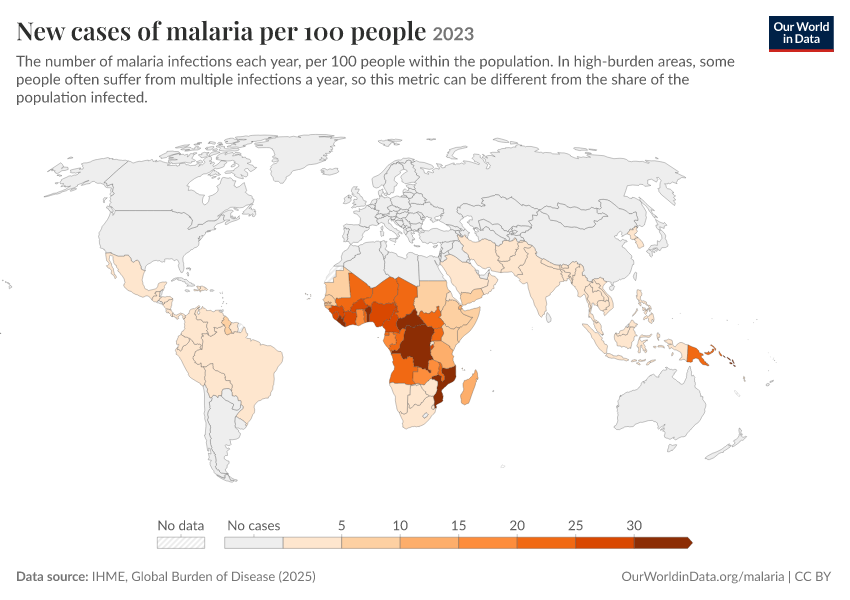
Malaria is an infectious disease present across much of the tropics and subtropics. In the map below, you can see the band of new infections across South America, South and Southeast Asia, and Africa.

The difference between sub-Saharan Africa and other parts of the tropics, though, is huge. Infection rates in sub-Saharan Africa are around 100 times higher than in South America and 50 times higher than in South Asia.
The fact that severe malaria is mostly an African story today is even clearer when we look at where people die from it. More than 95% of the 600,000 people who die from malaria every year live in sub-Saharan Africa. You can see this regional breakdown below.1
But this chart also makes clear that within sub-Saharan Africa, there are substantial differences in the burden.
Infection rates in sub-Saharan Africa are around 100 times higher than in South America and 50 times higher than in South Asia.
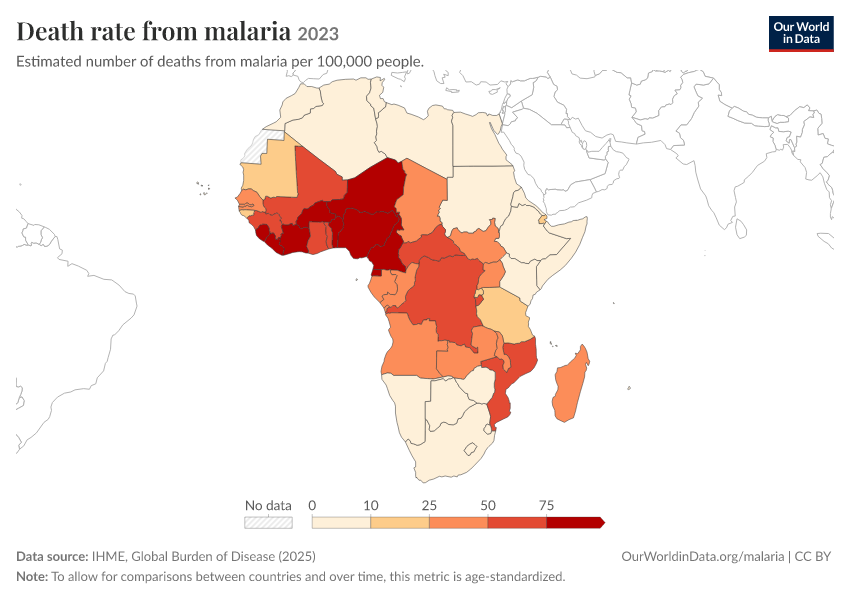
Around half of global deaths occur in West Africa — countries like Nigeria, Sierra Leone, Cameroon, Côte d’Ivoire, and Liberia. The rest are split between the central and eastern parts of the continent. Southern Africa has extremely low rates of malaria.
This dominance in West Africa is not just about population (we might expect more deaths in denser areas). As you can see in this map of death rates, those living in West Africa are at a much higher risk of dying from malaria.
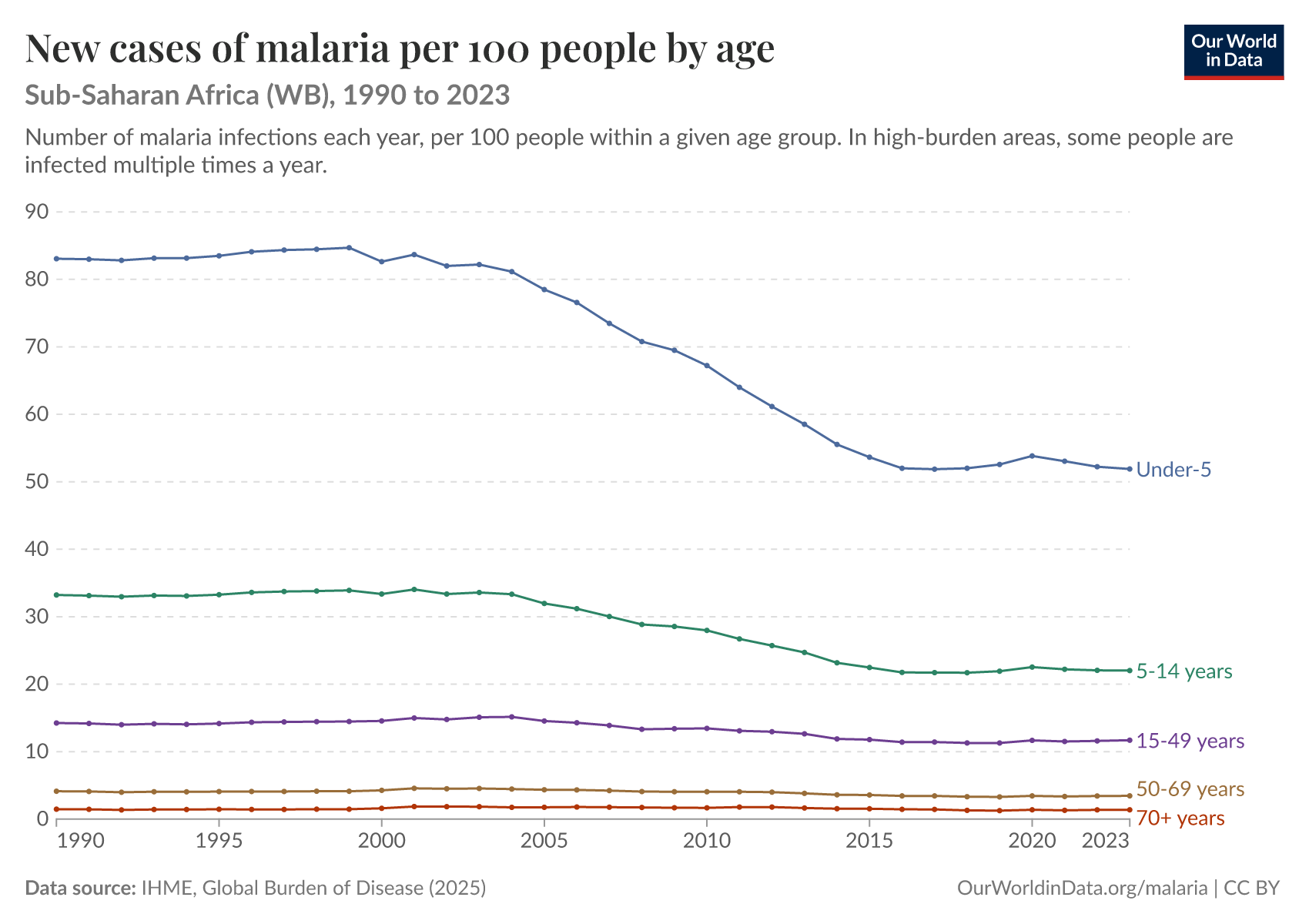
These are the important background facts to make sense of this article’s focus. Most deaths from malaria occur in sub-Saharan Africa. Within the continent, West Africa is hit the worst. And children are most at risk: tragically, around 70% of malaria deaths are among children. That’s almost half a million children dying of the disease every year.
To understand the link between malaria and climate change, we need to know the basics of the disease’s “perfect conditions”.
Several mosquito species in Africa carry and spread malaria. A dominant one is Anopheles gambiae. It carries and spreads the parasite Plasmodium falciparum, which is what infects humans.
Over many decades, scientists have studied the ideal conditions for these mosquitoes to thrive. The spread of malaria peaks in these species at around 25°C.2 Transmission drops close to zero below 16°C and above 34°C.
That means the suitability of malaria forms a bell-shaped curve like the one below. It spreads best at 25°C; this suitability drops on either side of it, and eventually becomes negligible.
Temperature is not the only thing that matters. How established malaria already is in a given country or region does, too. As do rainfall patterns: female mosquitoes lay their eggs in standing water, and larvae need water to develop. So, rainfall creates favorable conditions for malaria to spread. There is a limit, though: heavy, persistent rain often washes larvae away, preventing them from developing. An area with moderate rainfall is therefore a good breeding ground for malaria to spread.
Humidity can also have an effect. Adult Anopheles dry out in low-humidity air, so they often live longer in wetter, more humid seasons (and when they live longer, they do a better job of spreading the parasite).
The world has already warmed by around 1.4°C since pre-industrial times.3
What impact has this already had on the prevalence of malaria?
A recent paper by Colin Carlson and colleagues, published in Nature, estimated the impact of historical climate change on the burden of malaria so far, and projected how this might affect it in the future under different warming scenarios.4 The paper focused on the burden on children in Africa — as we established earlier, this is the most affected demographic, both in terms of cases and deaths.
They estimate that over the last century — from 1901 to 2014 — climate change has led to a small increase in the prevalence of childhood malaria across sub-Saharan Africa. By “increase”, they mean that rates were slightly higher than they would have been compared to a hypothetical scenario without climate change. The prevalence of malaria has actually declined in recent decades, but for reasons unrelated to climate.
Across the region, this increase was estimated at roughly 1 case per 1,000 children aged 2 to 10. To put this into context, around 24% of children (or 240 in every 1,000) in this region were estimated to carry the malaria parasite at the end of the study period. So, the overall impact has been relatively small and is quite uncertain. 59% of the study’s simulations showed an increase in malaria prevalence, with uncertainty ranging from a reduction of 4 cases per 1,000 to an increase of 6 cases per 1,000.
The bigger impact has been in changing the prevalence of malaria across different parts of the continent. Hotter temperatures might not have led to a large increase, on average, but they have affected its distribution.
Climate change has probably led to a decline in malaria in West Africa, but an increase in the southern and eastern parts of the continent. The following map summarizes this change: you see blue in the West but red, marking an increase, in the East and South.
Remember that West Africa is where the burden of malaria has been, and still is, the highest. A decline there due to climate change has been almost entirely offset by an increase elsewhere on the continent, which is why the effect, on aggregate, is very small.
The chart below shows malaria prevalence in two scenarios: the realistic one the world has lived through, and an alternate reality without human-driven climate change. Malaria has declined in West Africa due to climate change, but has increased in the other three subregions.
To understand why climate change has made things better in West Africa, but worse elsewhere, let’s return to our bell-shaped curve of where malaria thrives.
Climate change has probably led to a decline in malaria in West Africa, but an increase in the southern and eastern parts of the continent.
The study by Carlson and colleagues found results very similar to previous studies on the optimal conditions for malaria-carrying mosquitoes: transmission peaks at around 25°C.
In 1901, the average temperature in West Africa was around 26°C — very close to, but just past, the ideal temperature.5 Climate change has increased temperatures, pushing them away from the optimum and down the slope.
What has happened elsewhere? East and Central Africa started below the optimum, at around 22°C, and Southern Africa far below, at around 17°C. Higher temperatures in all of these regions have pushed them closer to the optimum. East and Central Africa now sit at around 24°C, and Southern Africa at around 18°C.
It’s this temperature effect that has driven these diverging patterns across sub-Saharan Africa. The authors of the study did not find a discernible signal of climate change in historical drought and flood trends.
What’s crucial is that, while climate change has, on net, probably increased the burden of malaria across sub-Saharan Africa, its impact has been small compared with the many interventions and investments made to control and alleviate malaria. Malaria cases and deaths have not increased, but fallen substantially over the longer term.
Infection rates in young children in sub-Saharan Africa fell by almost 40%. Death rates in the region have almost halved. As the authors note, the imprint of climate change is mostly masked by “the more than 200-fold greater overall reduction observed across sub-Saharan Africa over the same period”.
The climate dynamics that made malaria less prevalent in West Africa but more prevalent elsewhere on the continent will persist as temperatures continue to rise.
West Africa will, increasingly, become too hot for peak malaria. Central, East, and Southern Africa will be pushed towards it.
Of course, the level of these changes will depend on how much warming happens over the rest of the century (and that depends on our ability to reduce greenhouse gas emissions).
Colin Carlson and colleagues projected changes in malaria under three future warming scenarios: a very optimistic one that experiences the least warming (RCP2.6), a medium scenario (RCP4.5), and a very high scenario (RCP8.5), which is now considered implausible this century.6
In the chart, you can see the projected changes in prevalence across the different regions under these three scenarios. Again, this is the change relative to a counterfactual scenario without climate change.
In West Africa, the prevalence of malaria declines across all scenarios, and actually declines the most in the hottest one. In Southern Africa, which is currently farthest from the 25°C optimum, the opposite is true. Malaria is projected to increase across all scenarios (though in the hottest scenario, it starts to fall again in the second half of the century). Warmer temperatures here not only increase the prevalence of malaria in regions where it is already present; they also make malaria viable in higher-altitude areas, which are currently too cold. This is a concern because these are places without a historical experience of dealing with the disease — they would need to build capacity to manage and treat it.
In Central Africa, malaria falls in all warming scenarios, but not as strongly as in West Africa. In the east, the prevalence of malaria increases slightly under the low- and moderate-warming scenarios, as hotter temperatures push it closer to the optimum.
The following map shows how this change in prevalence looks across the subregions in the intermediate-warming scenario.
If we add up all these changes, the authors estimate that by 2100, climate change would reduce average prevalence by 1 per 1,000 children in the low-warming scenario and by up to 20 per 1,000 children in the very high scenario. The net effect is a decline in malaria because the region that experiences the worst impacts of malaria today — West Africa — could see a substantial reduction in a warmer world. And increases in other regions would not be enough to offset this reduction.
So far, we’ve mostly focused on the impacts of higher temperatures on the spread of malaria.
But climate change could affect malaria in another way: through extreme weather events. How can these events drive an increase in malaria cases and deaths?
Flooding can have an impact in several ways. After a flood has receded, huge areas of land — now covered in standing water — can become ideal breeding grounds for mosquito larvae. This is not immediate — larvae don’t do well when it’s too wet — but in the aftermath, as some of the water clears, conditions become ideal for rapid breeding and spread. Flooding can also disrupt healthcare facilities, infrastructure, and supply chains that might deliver insecticide-treated nets and antimalarials; all of these factors make it harder for the local community to respond.
This is what happened in Pakistan when huge floods hit the country in 2022. This caused a surge in malaria cases, which reached 4.3 million a year later — more than eight times the pre-flood level.7
The Carlson study does capture some of these changes. The authors find that extremely wet periods tend to increase malaria prevalence several months later. But these relationships are harder to establish than they are for temperature. Africa does not have a long or high-quality record of precipitation measurements, so the historical data they rely on is noisy and often sparse. While they might be able to capture some of the physical impacts of extreme rainfall or a flood, what’s harder to capture is the human response: its impact on infrastructure, healthcare facilities, or supply chains.
Another recent study — by Tasmin Symons and colleagues — sought to capture some of the wider impacts of extreme weather.8 The authors used 25 years of data on malaria, climate, control interventions, and socioeconomic conditions to estimate how this might change in the future. They found that climate change could increase the burden of malaria across Africa in the coming decades under a medium-warming scenario. The cumulative (not annual) increase between 2024 and 2050 would be approximately 123 million cases and 532,000 deaths. If we compare this to current annual cases and deaths, this would be equivalent to almost six months of additional cases over the next 25 years, and almost one additional year of deaths.9
The authors concluded that the biggest driver of this increase was not temperature or gradual changes in rainfall; 93% of the additional deaths were attributed to extreme weather events.
These estimates are quite uncertain for several reasons.
First, extreme weather events are particularly hard to predict. What makes it even harder is figuring out the downstream consequences; in the case of Pakistan, it would be hard to know ahead of time which infrastructure would be affected, how overwhelmed health facilities would be, and how long it would take for roads and supply chains to reopen.
Second, the authors assume that malaria control and socioeconomic conditions remain as they are today, so the only thing that changes is the disruption caused by climate change. That means it’s not a prediction of future deaths and cases, but a modeled estimate of what could happen if we do nothing.
Still, it’s very plausible that the Carlson paper we looked at misses a real effect of extreme weather, which would underestimate the projected impacts of climate change. This point is extremely important in how we respond to this risk: it makes accurate forecasting of extreme events, early warning systems, and flood defenses even more important. When we think of malaria prevention, we often focus on bed nets, vaccines, or drugs. If the impact of extreme weather is as large as this other paper suggests, improving overall disaster resilience will also be an important response.
One of the findings from this article is perhaps surprising. For someone who works on climate change, it’s actually an uncomfortable one. A warmer world might actually reduce the global prevalence of malaria in Africa.
But it would be wrong to conclude that climate change is a good or useful way to tackle the disease.
In West Africa, the prevalence of malaria declines across all scenarios, and actually declines the most in the hottest one.
The impacts in the coming decades will probably be very uneven. Yes, the burden might fall in West Africa, but other — and even new — parts of the continent will be pushed into a worse situation.
But there are ways we can reduce the burden of malaria without turning the disease into a zero-sum situation: we do not need to make things worse in one place to make them better elsewhere.
The effects of extreme weather are also highly uncertain, and in some places could override or offset any reductions that parts of Africa might see from higher temperatures.
The most important lesson is that the size of the difference we can make through effective interventions and investments is far bigger than the effects of climate change. We see this in the historical data: in recent decades, global deaths have fallen despite a warming world. This can continue in the future.
Basics like insecticide-treated bed nets and antimalarials have already saved many lives and can save far more if we ensure everyone who needs them has access. These interventions are not expensive. The world now has two malaria vaccines, giving us another vital tool to drive this disease to elimination.
Hotter temperatures alone might reduce the burden of malaria in West Africa, but we can and should do far better by implementing control measures and investing where needed. In a world where we commit to tackling malaria, the impact of climate change — whether positive or negative — could be small.
Acknowledgments
Thank you to Tamma Carleton for the provision of the underlying data to produce some of the visualizations in this article.
Thanks also to Edouard Mathieu for editorial feedback and suggestions.
Cite this work
Our articles and data visualizations rely on work from many different people and organizations. When citing this article, please also cite the underlying data sources. This article can be cited as:
Hannah Ritchie (2026) - “What impact will climate change have on malaria?” Published online at OurWorldinData.org. Retrieved from: ' [Online Resource] (archived on October 5, 2026).BibTeX citation
@article{owid-what-impact-will-climate-change-have-on-malaria,
    author = {Hannah Ritchie},
    title = {What impact will climate change have on malaria?},
    journal = {Our World in Data},
    year = {2026},
    note = {
}
Reuse this work freely
All visualizations, data, and articles produced by Our World in Data are completely open access under the Creative Commons BY license. You have the permission to use, distribute, and reproduce these in any medium, provided the source and authors are credited.
The data produced by third parties and made available by Our World in Data is subject to the license terms from the original third-party authors. We will always indicate the original source of the data in our documentation, so you should always check the license of any such third-party data before use and redistribution.
All of our charts can be embedded in any site.








Leave a Reply