
If you’ve ever tried to build an audience, you might have experienced the painful scenario of posting a piece of content you’re particularly proud of and… crickets.
As the supply of content increases, accelerated by the introduction of AI content tools, it’s harder than ever to earn attention.
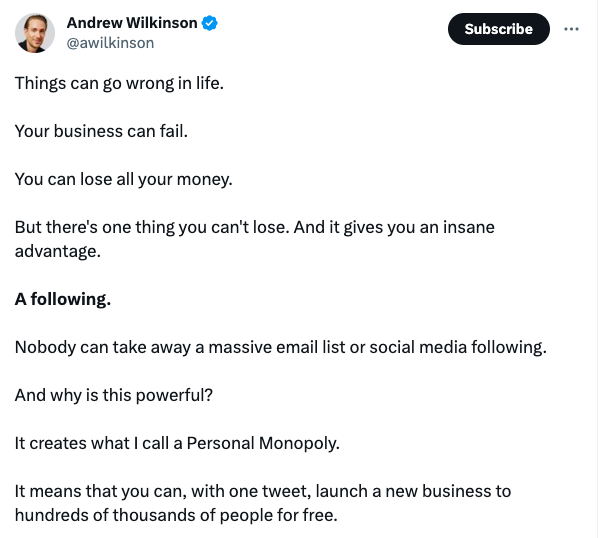
However, this also means that the value of attention is increasing, and those who succeed have more leverage than ever before. Famed investor Andrew Wilkinson sums this up well in the following tweet:
The good news is that building a new audience isn’t impossible.
It just requires a different strategy than before. So in this post, we’ll discuss a step-by-step strategy you can use to build an audience from scratch in 2026.
Want to learn how to create content that generates real leads and sales for your business?
Copyblogger Academy is where business owners learn how to turn content into a growth asset. You’ll get practical frameworks for writing, SEO, and distribution that help you attract the right audience and convert attention into customers. No more chasing likes and shares. The Academy will teach to create an eco system that turns content into cash.
Step 1: Select a Topic, Medium, and Angle
If someone consumes a piece of content you created and then follows you, it’s probably because they liked it and want to see more similar content. So if you change the topic and style of your content, you might lose those subscribers because they might not like the new topic or style of content.
As a result, you’ll find that your subscribers frequently churn, and you’ll struggle to build a loyal following.
This was a key mistake Eric Siu mentioned he made when building his YouTube channel. He discussed marketing in some of his YouTube videos, while in others, he discussed NFTs and cryptocurrency. His audience began unsubscribing as the audience interested in marketing didn’t care about his NFT videos, and the NFT audience didn’t care about his marketing videos.
So the key to building a sticky, loyal audience is selecting a topic, angle, and medium. Here’s how I define each of these:
- Topic: This is what you’ll talk about. Examples of topics include marketing, finance, food, travel, etc. Choose a topic you have unique knowledge about and are genuinely interested in. Content is a long game, and you’re much more likely to be successful if you have a genuine interest in the topic, as there will be a period of time when you won’t receive any reward for your efforts.
- Medium: This is how you communicate your content. Examples of mediums include video, text, or audio content. The key to choosing the best medium is to select one you enjoy and can produce consistently. Publishing consistency is key to long-term growth, so if you don’t think you can produce that medium of content weekly, choose a different medium. For example, if you don’t think you can produce video content each week, you might want to choose text-based content.
- Angle: This is how your content will provide a different perspective from other existing content. Similar to product-market fit, your angle is the differentiator that helps you achieve “content-market” fit. For example, if you’re starting a Japan travel vlog, how will it differ from existing Japan travel vlogs? Maybe you’ll interview local Japanese chefs and film them making a meal. The key to selecting a successful angle is to make it both unique and repeatable. For example, interviewing Japanese chefs and filming them making a meal is a repeatable format.
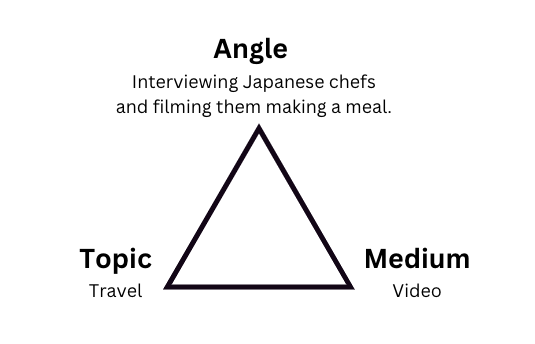
To help you choose your topic, medium, and angle, here are a few examples for inspiration.
Example #1: Justin Rowe
- Topic: LinkedIn Advertising
- Medium: Text (LinkedIn)
- Angle: He shares tactical breakdowns and case studies of of how to improve your LinkedIn ad performance.
Example #2: Sam Parr and Shaan Puri
- Topic: Entrepreneurship
- Medium: Podcast
- Angle: Casual business conversation between two seven/eight entrepreneurial friends.
Example #3: Caleb Simpson
- Topic: Rent
- Medium: TikTok
- Angle: Asks people on the street how much they pay for rent and then tours their apartments.
If you look through each of these individuals’ content, they cover roughly the same topic in a repeatable format.
Note: You’ll notice that they all have audiences across multiple different platforms (Twitter, YouTube, etc.). Below, we’ll discuss how you can take an omnichannel approach, but when you’re first starting out, it’s best to focus on just one medium on one platform.
Step 2: Create Content and Publish Regularly
The main cause of content failure is the creator quitting too soon.
Your first pieces of content probably won’t hit, and that’s okay. In the early days, the most important thing to do is to get the reps in and hone your abilities as a content creator.
So select a specific content topic, medium, and angle and commit to publishing consistently for the next three months.
Here are a few tips to help you publish consistently:
- Set a reasonable content publishing frequency. If you plan to publish every day, you’ll probably burn out quickly and give up. As consistency and a long-term vision are essential for content success, create just one piece of content, see how long it took you to produce, and then select a realistic publishing schedule you can realistically commit to for at least six months.
- Batch your content in advance. Many creators find it easier to produce several pieces of content in one sitting once they’re in the flow state rather than setting aside several content creation sessions throughout the week/month. Batching content also ensures you publish on time. You can also use a content calendar to schedule your content ahead of time.
- Outsource and automate non-creative work. Plenty of minor tasks are involved with content creation, from editing videos to scheduling social media posts, but these small tasks can quickly add up to hours each week. So use software tools to automate tasks or hire a virtual assistant on a platform like Upwork to help you. By offloading low-value tasks, you’ll have more time to dedicate to content creation, decreasing your chances of burnout.
Once you publish some content, you can ask for feedback from mentors and peer groups.
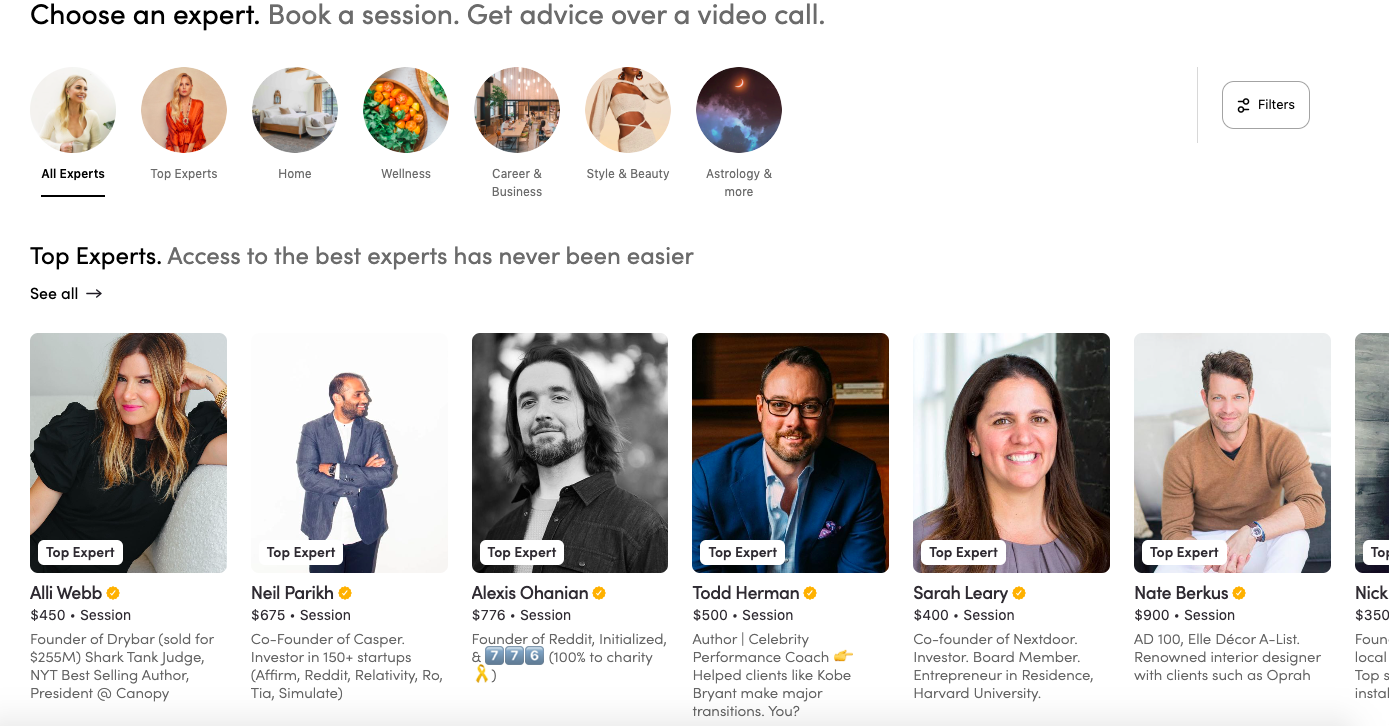
For example, platforms like Intro.co and Clarity.fm allow you to schedule mentorship calls with world-class experts.
Alternatively, you can join a community like the Copyblogger Academy, where you can ask me (Tim) questions and receive feedback from other peers. We also do Q&A sessions with top content creators.

If you want to learn more about how to level up your content creation skills, here are a few additional resources you can check out:
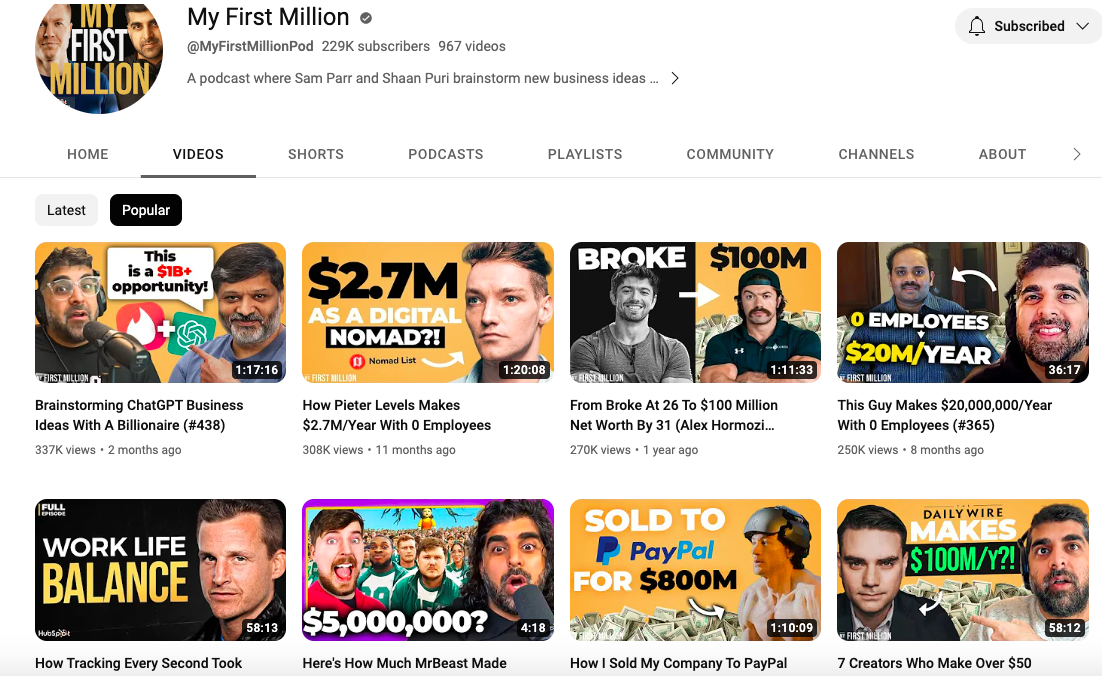
Another excellent method to improve your content is to study your competitors’ content and determine which content receives the most engagement or positive comments.
For example, if you produce video content on YouTube, you can filter by the most popular videos and then look for patterns and popular influencers to incorporate into your content:
Step 3: Partner with Existing Creators
There’s a misconception that as long as your content is high quality, it will naturally earn engagement.
Unfortunately, most algorithms (social media, search engines, etc.) give more visibility to content that earns a lot of traction and engagement within the first few hours.
When you’re starting, you probably only have a handful of followers, so your content won’t receive much engagement within the first few hours of publishing. Unfortunately, this means your content probably won’t receive much organic reach from the algorithms – even if the content quality is next-level.
This creates a vicious cycle that makes it hard to earn a following and receive more engagement.
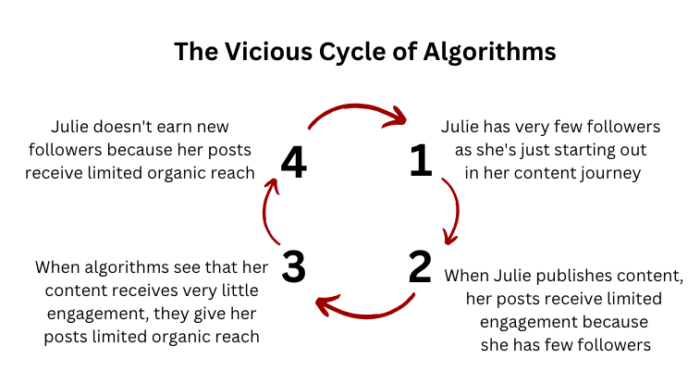
To break out of this cycle and help your content receive more organic reach, you need to promote your content. One of the easiest ways to do this is collaborating with an influencer that already has the attention of your target audience.
When they promote your brand to their audience, your content will naturally receive more impressions, which will help it receive more engagement and ultimately help you earn more followers.
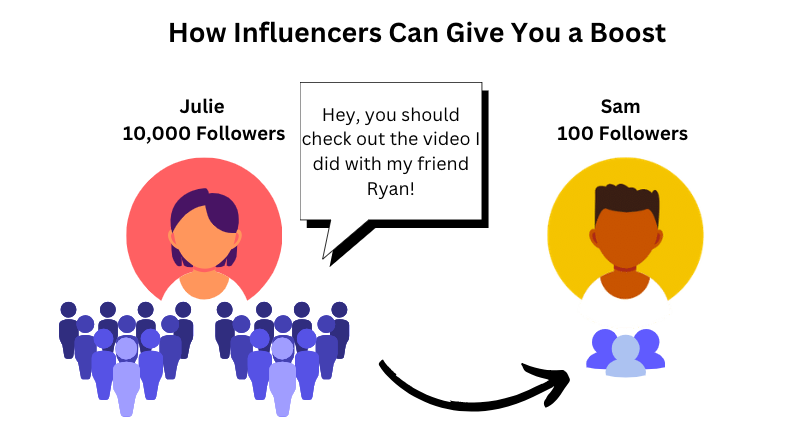
The tricky part is getting an influencer with a larger audience to agree to do a content collaboration with a smaller brand with a small audience.
As a rule of thumb, partnerships are most successful when incentives are aligned.
So before you ask an influencer to collaborate with you, ask yourself how this partnership will benefit them.
Some influencers agree to interview smaller brands if they can repurpose the content on their own social media accounts. As most influencers are already setting aside time to create their own content, many will agree to an interview with a smaller brand if they can use that content for their personal brand.
Alex Hormozi is a great example of this in action. He often repurposes all of the interviews he does as social media content, like this clip that he swiped from an interview he did on Impact Theory:

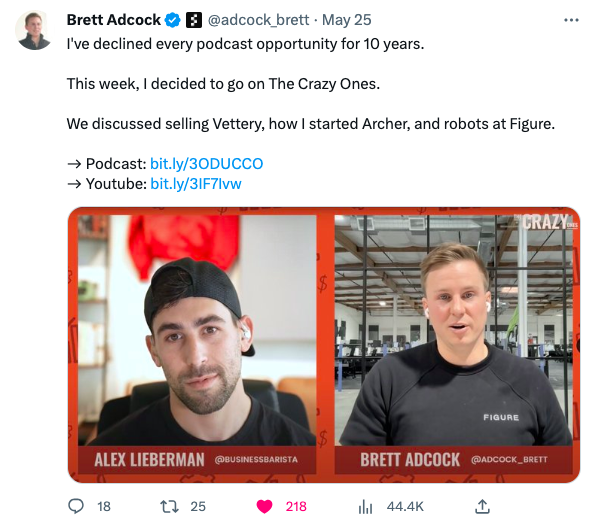
Many influencers also share the content when it goes live and give your brand a shout-out. Here’s a great example:
Not all influencers will agree to an interview, especially if you have a smaller audience. To increase your chances of receiving a “yes,” look for influencers that have recently done interviews with competitors that have a similar audience size.
You can also look for influencers launching a book, as they tend to be more open to interviews.
Note: Even if you’re just writing text-based content (like Twitter or LinkedIn threads), you can still interview someone and then write out the key points from the conversation and post that on your social media channels.
If you’re struggling to get an influencer to collaborate with you, consider paying for an interview. For example, you can use a platform like Intro.co or Clarity.fm to pay for calls with world-class experts.
You can also pay an influencer directly to promote your content. However, collaborations tend to be more effective as influencers are often more vested in the partnership when their own thought leadership is involved.
If you’re producing audio or video content, you can also offer written guest posts to blogs with similar audiences and simply ask that they insert the video or podcast link somewhere inside the guest post. For example, popular car YouTuber Doug DeMuro got his first several thousand YouTube subscribers by writing for the car blog, Jalopnik, and then inserted his videos into the written content.
Finally, you can also pay to promote your content on social media platforms like Facebook, Instagram, or Twitter.
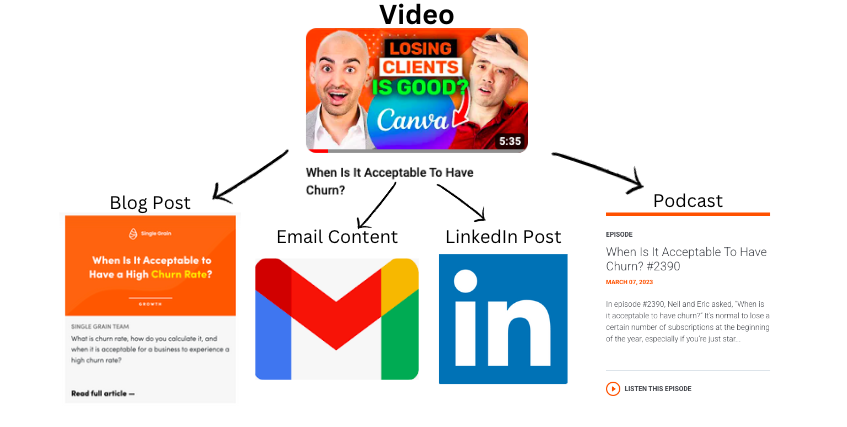
Once you’ve established a solid publishing schedule for your main channel, the best method to increase your output and reach with minimal additional effort is to adopt an omnichannel approach.
For example, if you’re already creating video or podcast content, you can chop that video up into multiple shorter clips and post it across social media platforms like LinkedIn, TikTok, and Instagram.
This allows you to scale reach and engagement exponentially, as your single long-form video is now ten or twenty pieces of content.
Eric Siu and Neil Patel do a great job of repurposing the content for Marketing School. You can see an example here:
To help you automate this process, you can use a tool like Repurpose.io. Or, if you’d prefer to outsource the entire process, you can hire an agency like Shortzy to do it for you.
For example, you can also put the video script into an AI content writer tool and ask it to write a blog post or social media content based on the script.
The key to succeeding with an omnichannel approach is optimizing each piece of content for the platform on which you intend to publish it. For example, if you’re repurposing a piece of content on TikTok, optimize it with subtitles and edit it in the fast-paced style of content that TikTok users like to consume.
If you feel overwhelmed at the prospect of repurposing your content across multiple additional platforms at once, choose just one additional platform and then add more as you become comfortable repurposing.
Step 5: Double Down On What’s Working
The content marketing landscape is always changing, and the marketing campaigns that work today might not work as well a year from now. So as you grow your audience, consistently collect audience feedback to learn what content resonates best and then produce more of that content.
Look at your content marketing metrics and double down on the partnerships and marketing strategies that drive the most audience growth.
Many entrepreneurs become distracted by new trendy marketing tactics, but the key to long-term success is focusing on what works and doubling down on those marketing strategies.
While experimentation is a great way to discover more effective strategies, limit new marketing campaigns to just one or two per month. Other than that, focus all your efforts on the top two or three marketing campaigns currently driving the most growth.
For example, if email marketing promotions currently drive 50% of your growth, double down on doing more email campaigns.
Bonus: Consider Different Monetization Strategies
The purpose of building a following is to eventually convert them into paying customers, but when and how you monetize will significantly impact the long-term revenue you receive.
First, monetizing too early can cause your audience to lose trust in your brand, and many will either unfollow you or ignore your offer.
You can think of the trust you build like a bank account – the more value you provide and the longer you wait to withdraw, the more you can ask for when you pitch an offer.
So how do you know when you’ve built enough trust that you can make an ask?
There isn’t a hard and fast subscriber count or engagement rate, but a great test is to make a small non-monetary ask and see how many people respond. For example, you can ask your audience to respond to a specific question in the comments or on social media.
You can also use a sentiment analysis tool like Awario or Brandwatch to gauge your audience’s general sentiment and identify specific audience complaints.
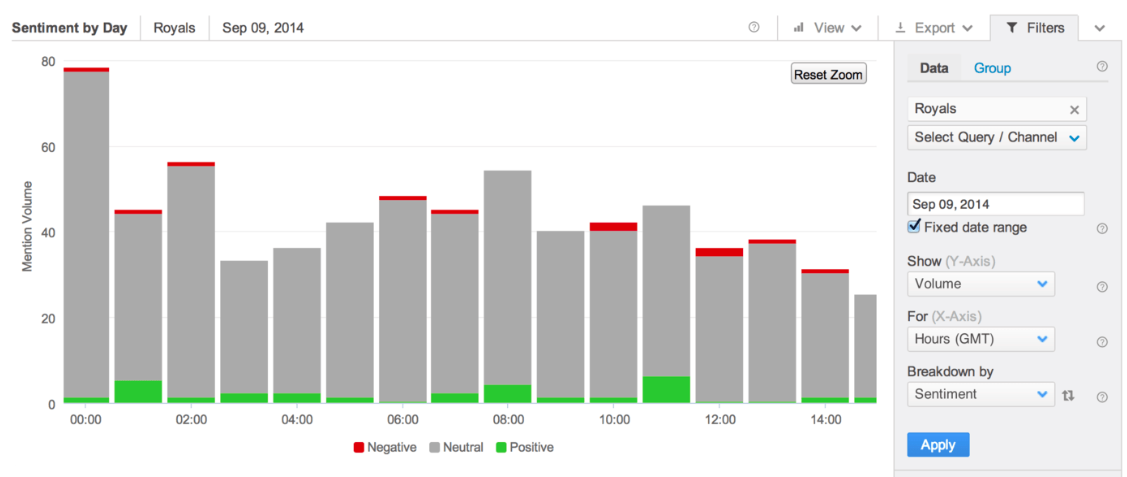
Responding and engaging with your audience is also a general audience-building best practice, so you’ll probably be able to estimate your audience’s loyalty based on the comments you read daily.
Once you feel that you’ve built a loyal following and have reached a stage in the business where it makes sense to monetize it, there are several different monetization strategies. Here are a few you might consider:
- Start a business: This strategy is probably the most work, but it’s also the most profitable long-term monetization method. Ryan Reynolds’ business, Mint Mobile, is an excellent example of a billion-dollar business created mainly on the back of a single influencer’s audience.
- Offer a course: This is one of the most popular audience monetization methods, and Ramit Sethi and Pay Flynn are excellent examples of content creators that have built multi-million dollar course businesses off of their audience.
- Affiliate sales: There are always plenty of product businesses that need promotion, so you can partner with other brands and offer their products and services to your audience. When your audience purchases those products, you receive a commission. This is a great way to quickly generate revenue, but it isn’t as profitable or long-term focused as the previous two options. The Influencer Marketing Hub is an excellent example of a website that built its audience through SEO and monetizes primarily through affiliate sales.
- Sponsored posts: This option is similar to affiliate sales, as you’ll be promoting other products or services to your audience, but instead of receiving a commission based on sales you generate, you’ll be paid a flat fee.
There isn’t a single best monetization strategy for everyone, and you can run multiple monetization strategies simultaneously.
The key to successfully monetizing your audience is taking a long-term approach and balancing the ratio of value to asks. You’ll lose credibility if you’re constantly promoting products and services, and your audience will eventually stop following you.
Start Building Your Personal Brand Today
As attention becomes more difficult to capture due to the increasing volume of content online, the value of attention will also continue to increase.
The good news is that as the volume of content increases (aided largely by the introduction of AI tools), the percentage of authentic content continues to decrease, so you can still stand out if you have a genuine, authentic message to share.
Your first few pieces of content probably won’t hit, but if you seek feedback, consistently hone your skills as a content creator and deliver an authentic message, you’ll eventually build a loyal following.
If you want to accelerate your skills as a content creator, consider joining a peer/mentorship group like the Copyblogger Academy. You can ask me (Tim) questions directly, and we also do regular collaborations with other top content creators like Amanda Natividad, Brian Clark, and Steph Smith. You’ll also have access to a group of supportive peers that you can lean on for advice, feedback, and inspiration.










Leave a Reply